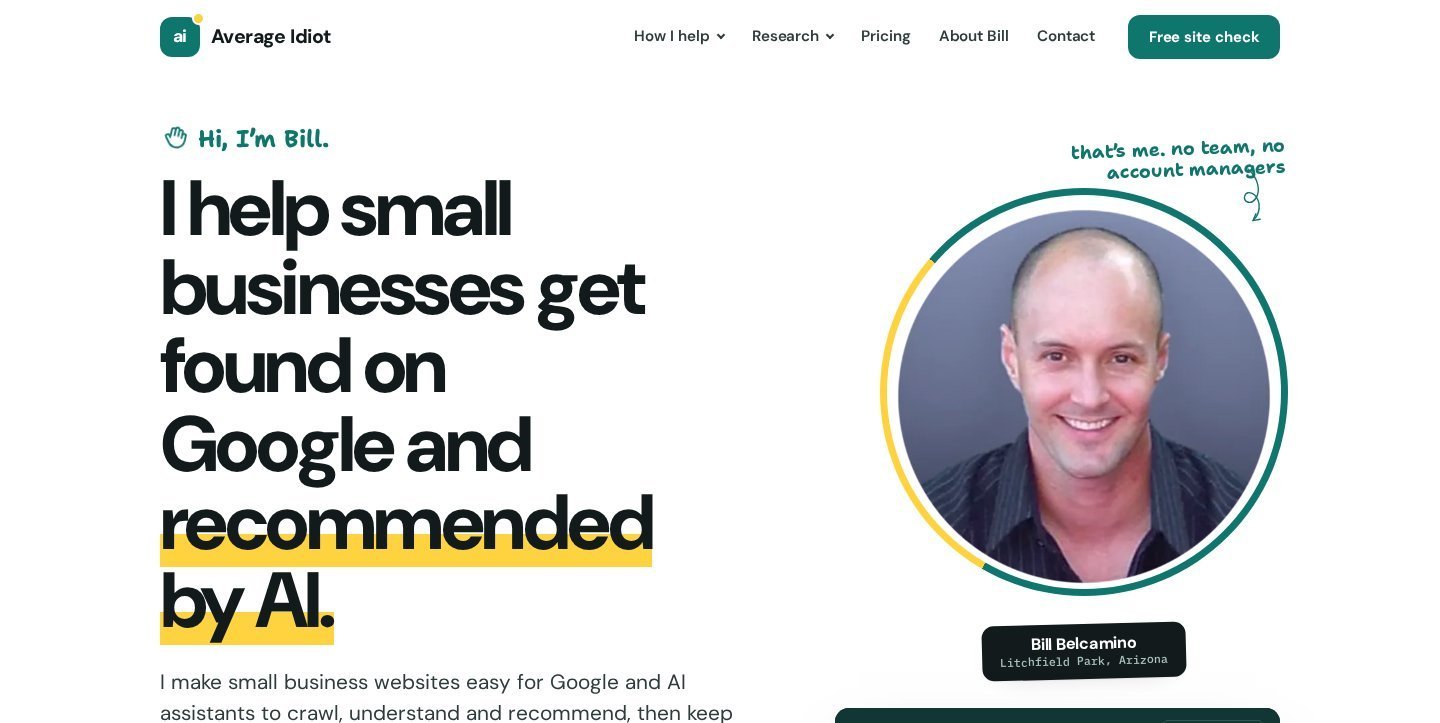
Bill Belcamino  ·  Litchfield Park, Arizona

Most consultants have never owned the risk.

I spent nine years as an engineer at HP, took a software company past 200,000 users as COO, and owned Google’s $70-million-a-year syndication partnership at Alot.com. Then I spent thirteen years building my own properties, where being wrong cost me my own money. Now I help founders and teams work out what is actually broken online — and fix it.

Currently directing search & strategy for law firms at Ten Golden Rules

Bill Belcamino
Fig. AEngineer by training
Fig. BOperator by experience
Fig. CMarketer by choice
Fig. DOwn money at stake

Where the risk was real

HPAuctivaeBayAlot.comGoogleBrandetizeTen Golden Rules

Track record

Nine years employed · Thirteen years exposed

200,000+ Users on the eBay selling platform I ran as COO
$70M Annual Google search syndication partnership I owned at Alot.com
$3M Cost avoidance delivered at HP managing global repair suppliers
13 yrs Running my own brands and portfolio, with my own money at stake

Who I am

Engineer by training. Operator by experience. Marketer by choice.

Most problems are systems problems — and the interesting part is usually the part nobody is measuring.

I started with an electrical engineering degree from Chico State and spent almost nine years at HP as a product development engineer, program manager and supplier manager. That is where I learned to look past the symptom to the system underneath it.

I left to become COO of Auctiva, which became the number one third-party selling platform on eBay — $20 million a year and past 200,000 users. From there I went to New York as VP of Product at Alot.com, where I built the brand from scratch and was the person on the phone with Google about a syndication partnership worth $70 million a year.

Then I did something most people at that level do not do: I stopped taking the next title and spent thirteen years building my own things. PPC arbitrage into CPA offers, affiliate systems, Amazon FBA, domain portfolios, blog networks in genuinely competitive niches. No salary, no cover. If a decision was wrong, I felt it in my own bank account.

Receipts from those years

$100K Profit in a single year running PPC arbitrage into CPA offers
35,000 Email subscribers built from scratch in a niche community I owned
~$300/day Daily revenue that list produced

Since then I have led SEO for Brian Tracy, Jack Canfield and Rule #1 Investing at Brandetize, consulted independently, and now direct search and strategy for law firms at Ten Golden Rules. The through-line is the same one it has always been: work out what is really happening, fix what is genuinely broken, and build something that keeps working when nobody is watching.

Chico State BS, Electrical EngineeringWhere systems thinking started
9 yrs Hewlett-PackardProduct development engineer, program manager, supplier manager
COO Auctiva#1 third-party eBay selling platform · $20M/yr · 200,000+ users
VP Product Alot.com · MIVABuilt the brand from scratch; owned the $70M Google partnership
13 yrs My own propertiesPPC arbitrage, affiliate systems, Amazon FBA, domains, blog networks, a 35K-subscriber list
SEO Lead BrandetizeBrian Tracy, Jack Canfield, Rule #1 Investing
Now Ten Golden RulesDirecting search & strategy for law firms · Litchfield Park, AZ

What I do

Diagnosis first. Then the work.

Four areas — though most engagements start as one and turn out to be another. That is usually the useful part.

SEO and organic growth

Technical audits and cleanups, search intent and funnel-aligned keyword strategy, content architecture and topic clusters, and frameworks built for how AI search actually cites sources now.

Websites and systems

Site structure, internal linking and navigation. Performance, caching, redirects and schema. DNS, SSL and CMS problems that everyone else has given up on. Content workflows that match the team that has to run them.

Content, media and messaging

Long-form content, landing pages and resources. YouTube and podcast presence. Email sequences and nurture flows. Messaging that sounds like a person rather than a committee.

AI and workflow design

AI as a lever, not a gimmick. Research and ideation workflows, drafting pipelines with humans still in control, and systems that speed up good decisions rather than mass-producing bad ones.

What people say

From the people who were there.

Fifteen recommendations written on LinkedIn between 2008 and 2026 — by the people who managed Bill, reported to him, and shipped alongside him. Longer ones are excerpted; all are public on LinkedIn.

“One of his biggest strengths was his ability to bridge the gap between AI and management. Bill has extensive knowledge of implementing AI solutions into business workflows, which helped improve operations, make our department more effective, and create a better experience for our clients. I’d recommend Bill to any organization looking for a leader who understands both the people side of management and how AI and emerging technology can be applied strategically.”
Carlos AriasMarketing Engineer for Law Firms Reported to Bill directly · 2026
01 / 15

Working together

Four ways in.

If you are not sure which one you need, that is normal — and it is usually the first thing worth figuring out together.

Focused audits and fixes

Short, intensive engagements that diagnose a specific problem and lay out the clearest path forward. Often with the implementation included, because a diagnosis nobody acts on is just an invoice.

Project work

Larger initiatives with a clear beginning, middle and end: SEO overhauls, site restructuring, content system design, launch support for a new product or brand.

Fractional leadership

Part-time ownership of your search and digital strategy, so somebody is thinking about the whole system while your team executes. Includes mentoring your internal marketers.

Not sure yet

Plenty of the best projects started with “this should be working better than it is.” If that is where you are, a conversation costs nothing and usually clarifies more than a proposal would.

Start here

If something should be working better than it is.

Send a short note: who you are, what you do, and what you think is not working. If I can help, I will tell you how. If I am not the right fit, I will tell you that too — and usually who is.

DIAGNOSIS FIRST